We’ve shipped a new round of updates to improve checkout-rate accuracy, reduce manual order edits, and make order and customs information easier to manage.
📦 Shopify checkout and product data
Shopify: Import item dimensions directly from Shopify
You can now import product or variant dimensions from Shopify metafields. This helps keep dimensions aligned between Shopify and Starshipit, allowing packaging calculations to use more accurate product data upon import.
- Choose whether dimensions should be imported from product or variant metafields.
- Make sure the relevant Shopify metafields contain length, width and height values.
- Go to Settings > Integrations > Shopify integration settings and enable product dimension metafield imports.
- Learn how to import Shopify product dimensions →
Shopify: More accurate checkout rates for individually packaged items
Shopify checkout rates can now calculate each item or unit as its own package. This is useful for oversized products, items that ship in their own boxes, or orders where each unit needs to be rated separately.
- Go to Settings > Checkout Rates > Packaging settings.
- Select Pack each item separately – Rates calculated using item weight and dimensions (one package per item).
- Make sure Use product catalogue on checkout is enabled and product dimensions are configured.
- Learn more about packaging settings for checkout rates →
Shopify: Import country-specific tax IDs for South Korea and China
Country-specific tax IDs collected through Shopify can now be used for shipments to South Korea and China, reducing manual entry for international shipments.
When enabled, destination identifiers such as South Korea’s PCCC and China’s resident ID are imported from Shopify’s localised order fields. These details are passed to DHL Express as receiver registration information and can be used by Australia Post as the international import reference.
- Go to Settings > Integrations > Shopify integration settings > Advanced.
- Enable Import country specific tax IDs.
🧩 Platforms
Neto: Import individual products from bundles
Neto bundles can now be expanded when they are imported into Starshipit. Instead of showing only the bundle SKU, the individual component products are added as separate order line items.
This makes bundle orders easier to pick, pack and validate against the products that physically need to be shipped.
- Go to Settings > Integrations > Neto integration settings.
- Enable Import kit/bundle components as separate item lines.
Katana: Import shipping method and shipping amount
Katana orders can now import their shipping method and shipping amount into Starshipit. For example, methods such as Standard or Express can be carried across with the order instead of needing to be entered manually.
- No additional setup is required.
- Shipping information is imported automatically when it is available on the Katana sales order.
🌏 Shipping internationally
NZ Post International: Updated customs declaration options
NZ Post CN22 and CN23 Nature of Transaction options have been updated with clearer B2B and B2C values. These changes support updated international customs requirements and make it easier to provide accurate export-reason information.
- Go to Settings > Couriers > NZ Post International settings.
- Make sure the Default Export Type dropdown is set to the applicable reason for export.
FedEx: Add SKUs to commercial invoices
FedEx commercial invoices can now include the product SKU in item descriptions. This can help with returns, finance reconciliation and duty-drawback workflows where SKU-level information is required.
- Go to Settings > Couriers > FedEx settings.
- Enable Add SKU to product descriptions.
UPS: Add declaration text to commercial invoices using rules
Rules can now apply declaration text to UPS commercial invoices. This helps ensure consistent customs wording is applied automatically to shipments that require a particular declaration.
- Go to Settings > Rules and create or edit a rule.
- Add the action Set Invoice Declaration Text.
- Enter the declaration wording that should be applied.
🧾 Order management
eBay: See the buyer’s username in the Orders grid
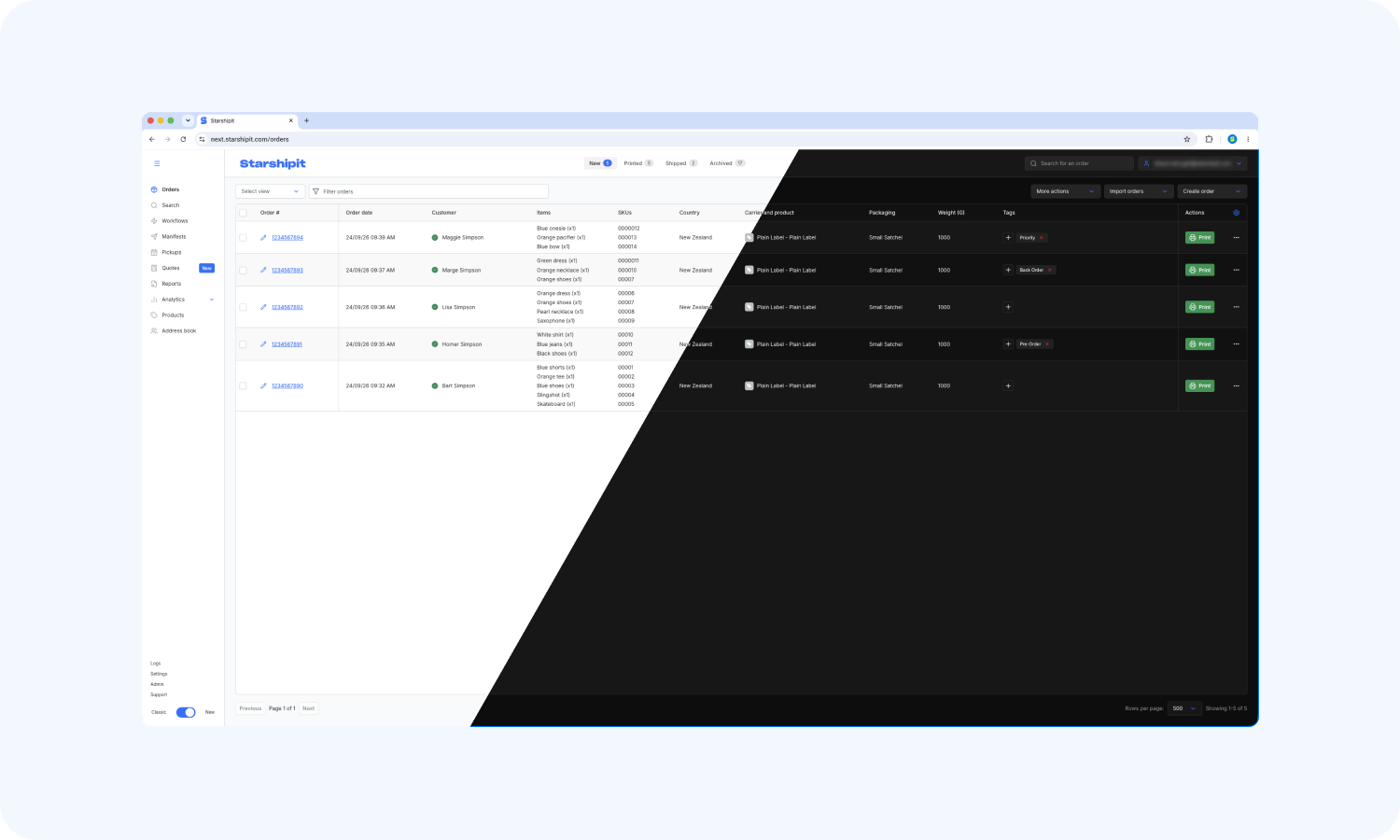
The buyer’s eBay username is now imported as the order reference and displayed in the Orders grid. This makes it easier to identify and group orders from the same buyer, particularly for eBay Live fulfilment workflows.
- Go to Settings > Integrations > eBay settings.
- Enable Import buyer username as reference.
⚙️ Rules
Shipping Zones: Exclude zones from rules
Shipping Zone conditions now support is not logic. This makes it easier to route, price or manage orders based on destinations outside a selected zone.
- Go to Settings > Rules and create or edit a rule.
- Choose Shipping Zone as the condition.
- Select is not and choose the zone that should be excluded.
Need help using any of these updates? Visit our Support Centre or log a ticket with the support team.